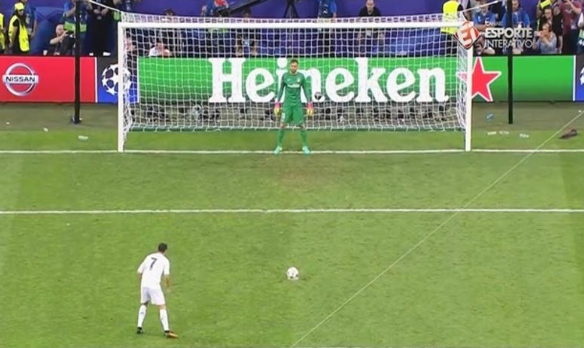
A penalty is one of the most dramatic moments in football. A single whistle, a short run-up, and one touch of the ball can turn the tide of a match, change the players' mentality, and alter the course of the game.
Therefore, understanding what is a penalty not only helps fans understand the rules but also provides a deeper perspective on technique, tactics, and psychology. When following Xôi Lạc TV, viewers can pay attention to both the reason behind the penalty and how the two teams respond after the referee's decision.
Overview of Penalties and Their Tactical Value
In essence, what is a penalty?, A penalty is a direct free kick taken from the penalty spot, 11 meters from the goal, awarded to the attacking team when an opponent commits a direct-free-kick offense inside their own penalty area while the ball is in play. The taker faces the goalkeeper from a short distance, giving them a high chance of scoring.
Overview of penalties and their tactical value
For viewers interested in KQ Bóng Đá, a penalty can also be a factor capable of changing the score within seconds. A team that is actively defending can lose its advantage because of one inaccurate challenge, while the team awarded the penalty has an opportunity to turn pressure into a goal and gain a strong psychological boost.
What Is a Penalty and What Are the Important Rules?
Xoilac Live is an option for fans to follow dramatic matches while also observing more clearly how a decision from the 11-meter spot can completely change the story on the pitch.
What Is a Penalty and What Are the Important Rules?
When Does the Referee Award a Penalty?
To understand what is a penalty in practice, it is necessary to start with the conditions that lead to the decision. Not every collision inside the penalty area is a penalty. The defending player must commit an offense that falls under direct-free-kick offenses, such as pushing, pulling, kicking, illegally tackling, obstructing, or handling the ball in violation of the rules inside their team's penalty area.
The referee also considers the continuous development of the play, advantage, and the severity of the impact. VAR can assist with controversial situations, especially when an offense occurs from a difficult viewing angle. As a result, the evaluation process increasingly relies on thorough verification. XoilacTV viewers can also review the incident to better understand the decision instead of looking only at the final result.
The Procedure for Taking a Penalty From the 11-Meter Spot
In actual situations, Xoilac Tivi helps viewers observe more clearly how the player positions themselves correctly, how the goalkeeper prepares, and how they react after the kick. KQ Bóng Đá after the match also shows how a small decision can make a major difference.
Common Fouls That Create a Turning Point
On Xôi Lạc TV, viewers can also easily identify shirt pulling, bringing down an opponent, poorly controlled tackles, or handling the ball in violation of the rules as actions that can lead to a penalty. In particular, an offense committed when the opponent has a clear opportunity can create enormous pressure on the defense, because the consequence is not only an 11-meter kick but may also involve a disciplinary card.
From a tactical perspective, the defending team must minimize risky actions inside the penalty area. A defender may win most of their challenges, but a single mistimed tackle can be enough to erase all their previous efforts. Therefore, top teams often train their ability to maintain defensive distances, choose the right angle when closing down, and control their movements. Following KQ Bóng Đá after the match also helps assess the impact of these decisions on the result.
Penalty-Taking Technique and the Psychological Battle
Choosing the Target and Executing the Shot
Understanding what is a penalty is only the first step, because the effectiveness of the kick depends on technique and decision-making. The taker can choose a low corner, high corner, central area, or change direction based on the goalkeeper's habits. Power, accuracy, run-up rhythm, and the point of contact with the ball must work together to create a trajectory that is difficult to stop.
Some players prefer to strike powerfully toward the far corner, while others use a controlled side-foot finish for greater accuracy. Some also choose the Panenka, a soft chip toward the center when the goalkeeper has already committed to one side. This is an artistic approach but also a high-risk option. On Xôi Lạc Trực Tiếp, such moments often become highlights of major matches.
Penalty-Taking Technique and the Psychological Battle
Psychological Pressure and Reading the Goalkeeper
According to Xôi Lạc Link, a penalty is a battle between two minds before it becomes a contest between two pairs of feet. The taker must control their heart rate, maintain confidence, and decide where to place the ball within a very short period. The goalkeeper, meanwhile, tries to create pressure through eye contact, positioning, body movement, and the ability to predict the opponent's habits.