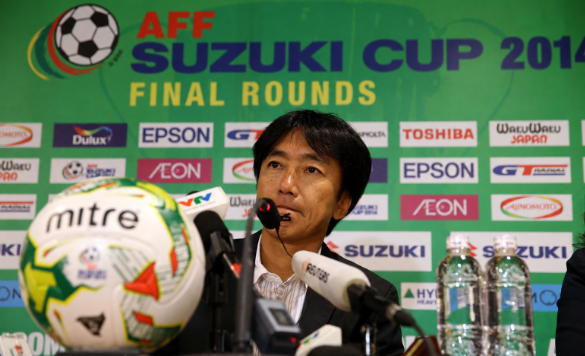
Without a flashy media presence, head coach Toshiya Miura still left a distinctive chapter in the history of Vietnamese football through discipline, physical fitness, and a determined working style.
The Japanese manager coached both the national team and U23 team, producing several memorable results while also sparking debates about his player-selection philosophy.
For fans who follow bong da truc tuyen, his journey is worth looking back on before Vietnamese football enters a new cycle.
Biography and Coaching Journey of Head Coach Toshiya Miura
Toshiya Miura was born on July 16, 1963, in Kamaishi, Iwate, Japan. Before coming to Vietnam, he coached Omiya Ardija, Consadole Sapporo, Vissel Kobe, and Ventforet Kofu. His experience in the J.League helped shape a philosophy that emphasized team structure, work rate, and tactical discipline. In May 2014, Miura signed a two-year contract with the Vietnam Football Federation to take charge of the national team and Olympic team.
The appointment of head coach Toshiya Miura attracted curiosity because he was not a globally renowned name. However, this allowed the Japanese coach to focus heavily on his professional responsibilities. In his first friendly match, Vietnam defeated Myanmar 6-0 in July 2014, creating a positive impact and raising expectations for a high-energy national team that was stronger in physical battles and more direct in its approach.
His Imprint at the 2014 AFF Cup and Asian Games
In 2014, head coach Toshiya Miura quickly made his mark. At the Asian Games in Incheon, Vietnam's Olympic team progressed from the group stage and reached the knockout rounds. At the AFF Suzuki Cup that same year, Vietnam topped Group A before reaching the semi-finals. Although they were eliminated by Malaysia, the team still demonstrated fast attacking play and a strong competitive spirit. This was a period when many fans turned to 90Phut to follow schedules and developments in regional football.
Miura's impact was not limited to results. He demanded that players move at high intensity, defend aggressively, and move the ball forward quickly. This approach differed from expectations of a team built around smooth possession football. As a result, he was praised for the team's fighting spirit while also facing debates over whether his style was fully suited to the qualities of Vietnamese players.
Success with U23 Vietnam and the Asian Qualification Spot
One of the most notable milestones of head coach Toshiya Miura came during the 2016 AFC U23 Championship qualifiers. In March 2015, Vietnam's Olympic team qualified for the final tournament as one of the best-performing runners-up, marking the first time Vietnamese youth football had secured a place at the AFC U23 Championship. At the 28th SEA Games in Singapore, U23 Vietnam went on to win the bronze medal.
During this period, viewers following bong da truc tuyen could easily see that Miura's team prioritized physical fitness and transitions. He gave opportunities to many young players but did not build the squad around a particular group of stars. When the Hoang Anh Gia Lai generation attracted significant attention, this approach generated even more debate. On 90p TV, his player selection and tactical effectiveness were frequently discussed.
Miura's Football Philosophy
One of the most recognizable aspects of head coach Toshiya Miura's philosophy was his high physical demands. He wanted players to press, compete aggressively, and maintain a high tempo. Defensively, the lines had to maintain their distances; after winning possession, the team would often move the ball forward quickly. This approach helped Vietnam adapt to a higher tempo, but at times it also made the build-up rushed and less fluid.
From the perspective of analyzing tỷ lệ kèo bóng đá trực tiếp, Miura's style produced unpredictable matches because the team could accelerate quickly but could also leave spaces when transitioning. 90 Phút TV was an option for fans who wanted to follow matches and form. Miura remained committed to his professional philosophy despite facing considerable criticism.
Controversies That Brought His Tenure to an End
After several positive milestones, the tenure of head coach Toshiya Miura came under greater pressure. Vietnam struggled in the 2018 World Cup qualifiers, particularly in matches against Thailand. At the 2016 AFC U23 Championship in Qatar, U23 Vietnam failed to advance from the group stage. At the end of January 2016, the VFF decided to terminate the Japanese coach's contract ahead of schedule.
The main debate centered on whether Miura placed too much emphasis on physical fitness and failed to fully exploit the technical qualities of Vietnamese players. Supporters argued that he made the team stronger and more disciplined, while critics believed that his fast-paced, long-ball approach was not always suitable. When following tỷ lệ kèo bóng đá trực tiếp, fans could also see that the results toward the end of his tenure lacked consistency. The topic was also widely discussed on 90m TV.
Return to the V.League and His Connection with Vietnam
After leaving the national team, Miura continued to maintain a connection with Vietnamese football. In early 2018, he returned to coach Ho Chi Minh City FC on a two-year contract. The arrival of head coach Toshiya Miura in the V.League attracted attention because fans wanted to see whether the style he had previously implemented with the national team could be effective at club level. However, his tenure did not last the full term, and he left the position in 2018.
His record at Ho Chi Minh City FC did not create a major turning point, but his return showed that Miura still had considerable appeal. Fans closely observed how the team organized its defense, movement, and player selection. 90P TV was also mentioned by the community when looking for places to follow match developments and analysis.
The Legacy of Head Coach Toshiya Miura from Today's Perspective
Assessing Miura solely through titles would not fully reflect the period in which he coached. He guided Vietnam to the semi-finals of the 2014 AFF Cup, helped the Olympic team advance from the group stage at the Asian Games, led U23 Vietnam to a bronze medal at the 28th SEA Games, and secured the country's first qualification for the AFC U23 Championship. These milestones demonstrate that his tenure had considerable value, even though it did not fully meet expectations regarding playing style.
More importantly, Miura emphasized physical fitness, discipline, and international intensity. Vietnamese football later developed in a different direction, but the lessons surrounding intensity and physical competition remain valuable. Looking back on his tenure, fans can see a period filled with controversy, where successes and limitations combined to create a memorable chapter in Vietnamese football.